Introduction to Weight Loss Surgery-
Weight Loss surgery is also known as Bariatric and Metabolic surgery. It involves alterations in the digestive system, especially the stomach and small intestine, to help in losing weight.
In addition to their ability to treat obesity, these operations are very effective in treating diabetes, high blood pressure, sleep apnea, and high cholesterol, among many other diseases. These operations also have the ability to prevent future health problems. The benefits allow patients with obesity who choose to undergo treatment to enjoy a better quality of life and a longer lifespan.
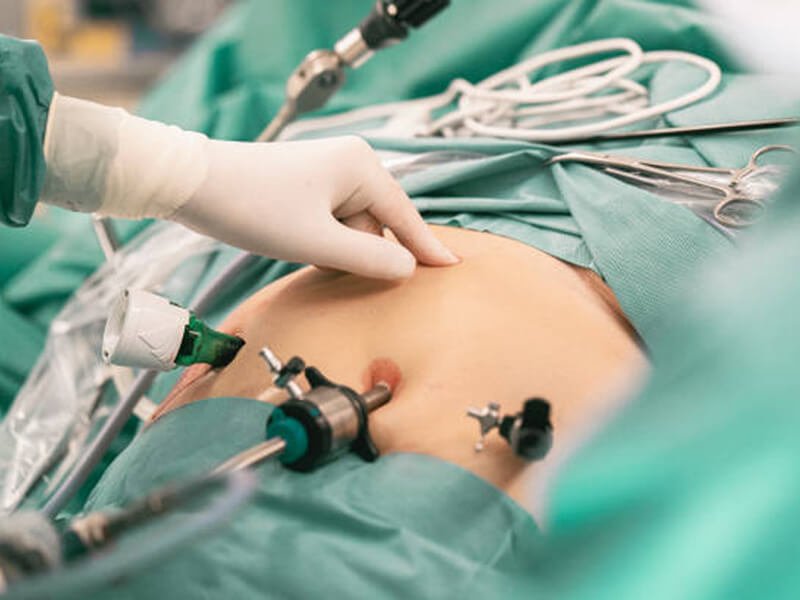
Today’s metabolic and bariatric operations have been refined over the course of many decades and are among the best-studied treatments in modern medicine. They are performed with small incisions using minimally invasive- laparoscopic surgical techniques. These advancements allow patients to have a better overall experience with less pain, fewer complications, shorter hospital stays, and a faster recovery. These operations are extremely safe, with complication rates that are lower than common operations such as gallbladder removal, hysterectomy, and hip replacement.
The goal of these operations is to modify the stomach and intestines to treat obesity and related diseases. The operations may make the stomach smaller and also bypass a portion of the intestine. This results in less food intake and changes how the body absorbs food for energy resulting in decreased hunger and increased fullness. These procedures improve the body’s ability to achieve a healthy weight. Bariatric surgery is done when the BMI is above 35 or lower with severe co-morbidities . Bariatric surgery is usually performed when diet and exercise are not helping and especially when the patient is facing serious health issues, like joint pain, heart issues, sleep apnea, depression, and infertility problems in males and females.
Bariatric surgery at REBORN HOSPITAL and expertise of Dr. Rohit garg and Dr Sandeep Singla
We have the best surgical department where we believe that Experience matters the most. For the same we have one of the most experienced surgeon. All types of laparoscopic Gynecological surgery , Minimal Invasive GI, and Bariatric surgery are available at Reborn Hospital. Bariatric surgery is done at Reborn Hospital by a team of our expert surgeons – Dr. Rohit Garg and Dr. Sandeep Singla who have vast experience in this field and have already performed no. of Bariatric surgeries. Patients are very satisfied with the results and enjoy a happy and healthy life.
Types and procedures
Bariatric surgery has the following three major type of procedures:
- Laparoscopic Roux-Y gastric bypass
- Laparoscopic Mini gastric bypass
- Laparoscopic Sleeve Gastrectomy
Laparoscopic sleeve gastrectomy procedure
Laparoscopic sleeve gastrectomy, otherwise called vertical sleeve gastrectomy or gastric sleeve method and is also a weight loss surgery that can help you save from many fatal issues as well along, the external edge of the stomach is resected, leaving a sleeve of the stomach, generally the size and state of a banana, and the pylorus, the muscle that controls exhausting of food from the stomach into the digestive tract. A sleeve gastrectomy is an absolutely restrictive procedure.
The sleeve gastrectomy, by decreasing the size of the stomach, permits the patient to feel full in the wake of eating less and taking in fewer calories hence also a weight loss surgery.
Sleeve Gastrectomy
Metabolic surgery for Diabetes
Diabetes is in a strong correlation with obesity, and the condition is also called diabesity. Type 2 diabetes is a chronic metabolic disease that refers to insufficient insulin production. On the other hand, the body fails to utilize the produced insulin effectively, which is also known as ‘insulin resistance. If not treated, blood sugar levels rise and negatively affect other organs of the body. As it is a progressive disease the patients who fail to achieve their blood sugar levels with a healthy diet, medication, overall lifestyle changes.
Bariatric surgery is often referred to as metabolic surgery due to its impact that ranges from weight loss to metabolic changes, especially on type 2 diabetes patients. Metabolic surgery is more inclined towards treating metabolic diseases such as heart diseases,
stroke, and especially type 2 diabetes.
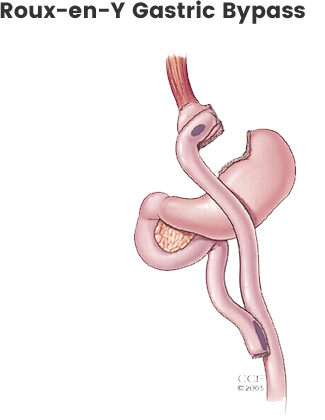
Laparoscopic Roux-en-Y gastric bypass is the type of bariatric surgery that diminishes the size of your upper stomach to a little pocket that is about the size of an egg. The food you eat then bypasses the remainder of the stomach and the upper piece of your small digestive tract. This outrules the process to absorb and retain the calories and fats from the food.
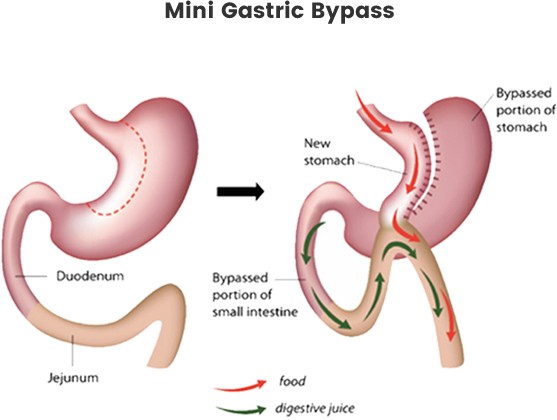
Laparoscopic Mini gastric bypass actually decreases the absorption of food in the stomach. Absorption of food in the stomach is decreased by removing most of the part of the stomach that includes the stomach, duodenum, and upper intestine from contacting with food.
Benefits of Bariatric Surgery
The following are the benefits of bariatric surgery:
Helps in fighting Diabetes.
Helps in fighting depression and anxiety
Improves fertility
Helps in relieving sleep apnea and joints pain
Improves Cardiovascular health
What is bariatric surgery, and what are the benefits?
Sleeve gastrectomy, gastric bypass, and duodenal switch are examples of weight loss surgery, commonly known as bariatric surgery, that functions by altering the stomach’s anatomy (or position) and small intestines. Changes in appetite, metabolism (how the body burns calories), and satiety (feeling full).
What is the maximum amount of weight I can reduce with bariatric surgery?
If you’ve had bariatric surgery, you’ll have lost between 30% and 40% of your excess body weight. In addition, you lose 1-2 pounds per week after gastric bypass surgery, so you’ll have lost 25-50 pounds in six months.
Am I a candidate for bariatric surgery?
You can be a potential candidate for weight loss surgery if your weight exceeds your ideal body weight by 100lbs. If your BMI is more than 35, along with serious negative health issues related to obesity, and you are unable to achieve your healthy body weight goals.
When can I be able to walk again after bariatric surgery?
On the evening of your procedure, you will be required to walk. Of course, you’ll be sore, but it’s the most effective technique to speed your recovery. In the hospital and after discharge, walk every two to four hours. One week after surgery, patients who do this report feeling remarkably good.
Can Bariatric surgery help me live longer?
Bariatric surgery may help you live longer if you are one of the following people:
- Type 2 diabetes is a disease that affects people of all ages (or other serious obesity-related health conditions)
- Overweight by at least 100 pounds compared to your optimal body weight
Able to make the lifestyle modifications that are recommended (daily exercise and low-fat diet)
Is Bariatric surgery risky?
In comparison with the life-threatening risks of obesity such as diabetes, hypertension, sleep apnoea, and various other morbidities, the bariatric surgery risks are minimal, and uncommon.
How will I know which bariatric surgery is right for me?
Your physician will consider your current health, weight, and goals for choosing the appropriate surgery for you.
Is there any minimum age for bariatric surgery?
The Body Mass Index (BMI) is calculated by multiplying the weight by the square of the body surface area. Candidates for this operation are those with a BMI more than 35 and obesity-related comorbidities.
How long must I remain in the hospital?
You will most likely be able to go home the day after your surgery if you are:
- Take in all of your fluids.
- Walking is going well.
- Using the bathroom.
Not being afflicted by uncontrollable nausea or vomiting.
Can bariatric surgery assist with other health issues?
Bariatric surgery, according to current research, can help to improve or resolve a variety of health problems, including:
- Diabetes
- Blood pressure that is too high
- Apnoea (sleep deprivation)
Triglyceride levels are high.
Is it true that laparoscopic bariatric surgery lowers these risks?gf
Indeed, laparoscopic bariatric surgery lowers the risks of an open surgery because it is minimally invasive and does not involve multiple inches long incisions. Further, less discomfort, a shorter hospital stay, a quicker return to work, and less scarring are the other advantages.
Is bariatric surgery beneficial?
Patients may lose 30% to 50% of their excess weight in the first 6 months after surgery and 77% of their excess weight as soon as 12 months. Another study found that 10 to 14 years following surgery, individuals might sustain a 50 to 60% weight decrease.
Recovery Time after Bariatric surgery
Duration of Bariatric Surgery
Before we explain how long recovery time after bariatric surgery takes, let us tell you Bariatric surgery usually takes 1 to 2 hours to perform. Surgery is done laparoscopically using small holes and a camera is inserted through that and the rest of the surgery is done after looking at the organs on a monitor. The pain in bariatric surgery is also quite less as compared to open surgery.
Hospital Stay after Bariatric Surgery
Recovery Time after Bariatric surgery includes Hospital stay after bariatric surgery which is usually 1 to 2 nights. Most people can even go back to their work after 14 days of surgery. So people recover quickly from bariatric surgery. Unlike open surgery bariatric surgery doesn’t hinder your daily activities majorly and you can get back to life immediately. The best part is that bariatric surgery involves very less scarring as compared to open surgery. Surgery openings are small and heal quickly throughout the maximum of 2 weeks.
Diet to follow after Surgery
As bariatric surgery involves cutting and connecting parts of the digestive system, therefore you will be on a special diet over six weeks almost. During these six weeks, your diet will be progressed from liquid food to semi-solid food and then eventually, you can start taking solid food. Recovery from Bariatric surgery is rapid and very less painful as compared to the open surgery.
Walking and carrying out activities after surgery
You can walk on your own feet after the surgery. Walking and little businesses increase circulation and will help to speed up recovery. The first night after the surgery, with the help of your nurse or physical therapist, try to walk at least three times and perform your leg exercises and breathing exercises regularly. You will not feel well doing that but you have to do that for speeding up your recovery. You will have to follow breathing exercises as these exercises keep your lungs properly expand. It is essential that after the surgery you stay physically active. While the dressings on the wound will remain there for seven days. If there will be any infection, you should right away see your doctor. You need to walk at a speed that will make you slightly short of breath and somewhat sweaty. Being socially active is also vital for wellbeing. You can even start swimming once your surgeon is sure that your wounds have healed totally. These exercises will also help to maintain weight loss.